
Introduction
In sports betting, many bettors are constantly looking for spectacular returns.
An ROI of 20%, 30%, or even 50% can seem particularly attractive.
By comparison, a 5% ROI may appear relatively modest.
However, in a market as competitive as sports betting, maintaining a 5% ROI over a substantial number of bets is an impressive achievement.
More importantly, that percentage can generate significant financial returns.
The reason is simple: profitability does not depend on ROI alone.
It also depends on total betting turnover, unit size, the frequency of betting opportunities, and the ability to maintain a statistical edge over time.
A 5% ROI on €5,000 in total stakes represents a €250 profit.
But the same ROI on €500,000 in total stakes represents a €25,000 profit.
The percentage has not changed.
The betting volume has transformed the financial result.
Let's examine how this works and why bankroll management plays such an important role.
1. What Is ROI in Sports Betting?
ROI stands for Return on Investment.
In sports betting, it measures the profit generated relative to the total amount wagered.
The formula is:
ROI = (Net Betting Profit ÷ Total Stakes) × 100
For example, a bettor places a cumulative total of €10,000 in wagers.
At the end of the period, the bettor has generated a net betting profit of €500.
The ROI is:
€500 ÷ €10,000 × 100 = 5%
This means the bettor has earned an average profit of €5 for every €100 wagered.
An important distinction must be made: sports betting ROI is calculated against total betting turnover, not the initial bankroll.
2. ROI and Bankroll Return: Two Different Concepts
Imagine a bettor with a bankroll of €5,000.
The bettor places 1,000 bets of €50 each.
Total betting turnover is:
1,000 × €50 = €50,000
With a realized ROI of 5%, the profit is:
€50,000 × 5% = €2,500
The bettor has therefore earned €2,500 using an initial bankroll of €5,000.
That represents:
50% of the initial bankroll.
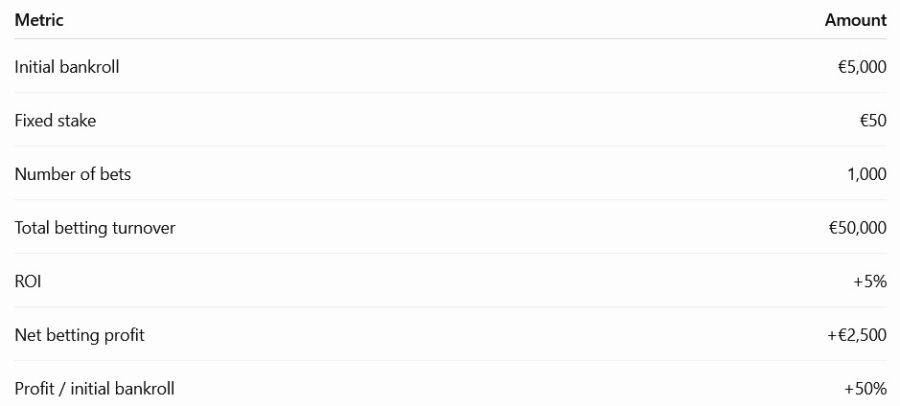
This distinction is fundamental.
A 5% ROI certainly does not mean that a bankroll can grow by only 5%.
3. The Secret: Bankroll Turnover
In sports betting, the same capital can be used repeatedly across different events.
This is known as bankroll turnover.
A €5,000 bankroll does not restrict a bettor to just €5,000 in cumulative wagers.
The bettor may place €25,000, €50,000, or more in total wagers over a year, provided sufficient funds are available when each bet is placed and bankroll management rules are respected.
Cumulative betting turnover can therefore represent several times the initial bankroll.
This turnover is what allows a seemingly modest ROI to produce a significant financial return.
4. How Much Can a 5% ROI Generate at Different Betting Volumes?
The calculation is straightforward:
Profit = Total Stakes × ROI
Here are several examples.
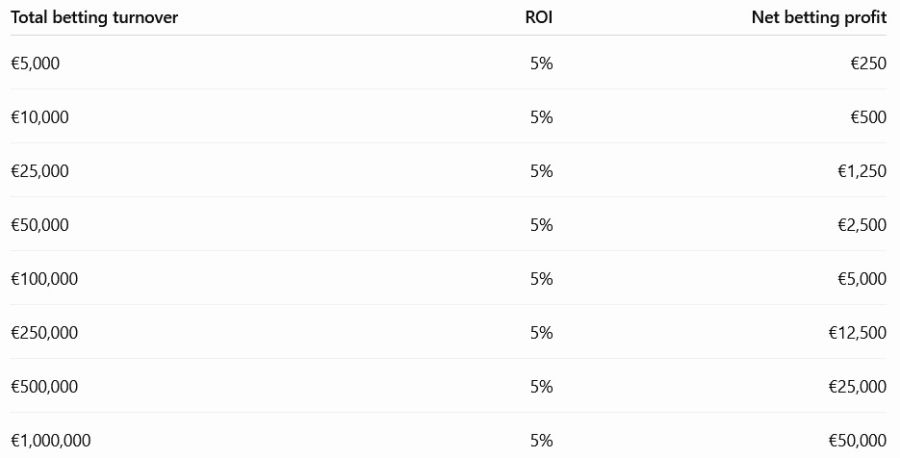
These figures illustrate a fundamental principle:
At a constant ROI, profit increases proportionally with betting turnover.
However, these are theoretical calculations. Maintaining a 5% ROI as stakes and betting volume increase is never guaranteed.
5. The Number of Bets Is a Key Factor
Let's return to our reference example:
Bankroll: €5,000
1U: €50
ROI: +5%
Here is how the results change depending on the number of bets.
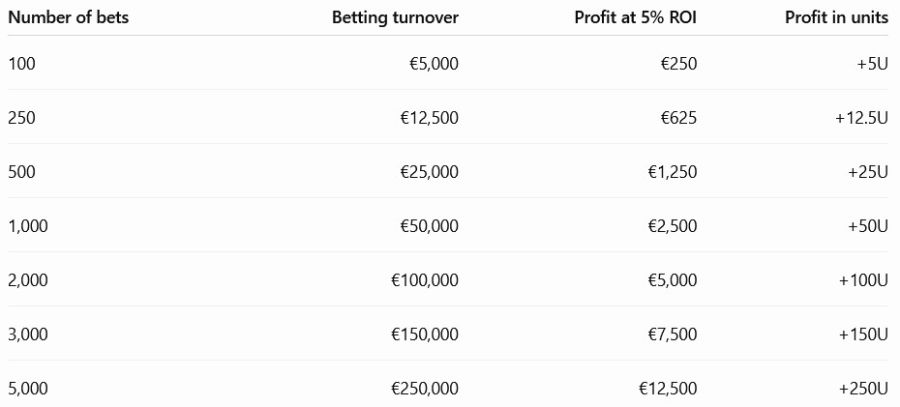
With a fixed €50 stake, a realized ROI of 5% across 2,000 bets produces a profit equal to the initial bankroll.
But there is an important condition.
The additional bets must continue to offer a positive statistical edge.
Increasing betting volume without an edge can accelerate losses instead.
6. Why a 5% ROI Is an Excellent Performance
Sports betting is a highly competitive market.
Bookmakers incorporate a margin into their odds.
The most liquid markets attract professional bettors, statistical models, and operators with substantial resources.
To achieve a sustainable positive ROI, bettors must consistently identify prices that are better than their estimated fair value.
A 5% ROI means that, after accounting for winning and losing bets, the resulting profit represents 5% of the total amount wagered.
Over a sufficiently large sample, this performance may indicate a genuine advantage.
However, an observed 5% ROI does not prove that a sustainable edge exists.
Sample size, odds, variance, and Closing Line Value must also be examined.
7. A 5% ROI Over 100 Bets Is Not the Same as a 5% ROI Over 10,000 Bets
Imagine two tipsters.
The first has:
ROI: +5%
Number of bets: 100
The second has:
ROI: +5%
Number of bets: 10,000
Their ROI is identical.
However, the statistical reliability of their results is very different.
Over 100 bets, a few favorable outcomes may explain much of the performance.
Over 10,000 bets, the relative influence of a handful of individual outcomes is generally much smaller.
This does not guarantee that the second tipster will remain profitable.
But the larger betting history provides more information for evaluating whether a genuine edge exists.
8. The Role of Sample Size in ROI Reliability
Sample size refers to the number of bets included in an analysis.
As the sample grows, it generally becomes easier to distinguish systematic performance from random fluctuations, provided the strategy's underlying conditions remain reasonably comparable.
A +15% ROI over 50 bets may largely reflect favorable variance.
A +5% ROI over several thousand bets deserves more serious statistical consideration.
Relevant metrics include:
- ROI.
- Sample size.
- Average odds.
- Win rate.
- Closing Line Value (CLV).
- Maximum drawdown.
- Consistency of performance over time.
ROI alone is never sufficient to evaluate the quality of a tipster or betting strategy.
9. ROI and Expected Value: What Is the Difference?
ROI measures an observed result.
Expected Value (EV) is a theoretical return calculated using estimated probabilities and the odds available.
Consider a selection offered at decimal odds of:
2.10 (+110)
Suppose its estimated true probability of winning is:
50%
The EV formula is:
EV = (Probability × Decimal Odds - 1) × 100
Therefore:
(0.50 × 2.10 - 1) × 100 = +5%
If the probability estimate is accurate, this selection has a theoretical EV of +5%.
But the bet can still lose.
Over 100 bets, the realized ROI might be negative.
Over 1,000 bets, it could be above or below 5%.
EV represents a mathematical expectation, not a guaranteed outcome.
10. Repeating a 5% Edge Can Become Powerful
Suppose a bettor regularly identifies opportunities with an EV of +5%.
The stake is €50 per selection.
The expected profit per bet is:
€50 × 5% = €2.50
That may seem insignificant.
But if the edge is real and repeatable:
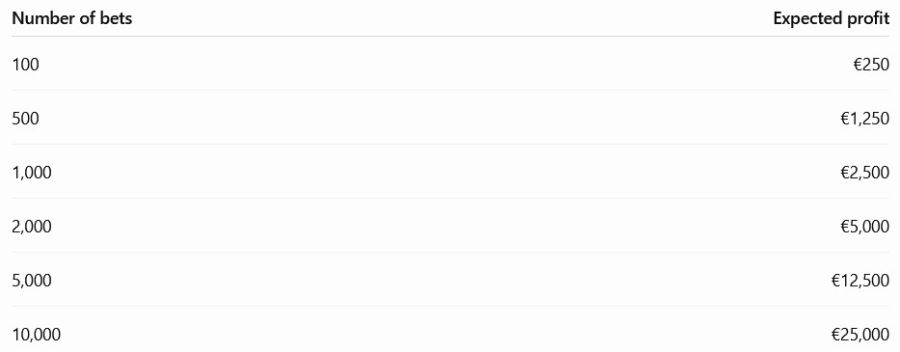
These are mathematical expectations, not guaranteed profits.
The power of an edge does not come only from its percentage.
It also comes from the ability to repeat it across a substantial number of bets.
11. Why a 20% ROI Can Be Less Attractive Than a 5% ROI
Imagine two betting strategies.
Strategy A
ROI:
+20%
Number of bets:
100
Stake:
€50
Profit:
€1,000
Strategy B
ROI:
+5%
Number of bets:
2,000
Stake:
€50
Profit:
€5,000
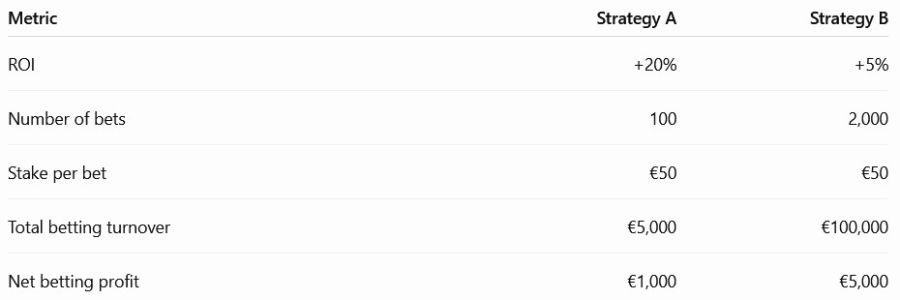
Strategy B has an ROI four times lower.
Yet it has generated five times more profit.
This is why betting strategies should never be ranked solely by ROI.
12. Betting Volume Must Never Come at the Expense of Quality
A common mistake would be to conclude:
"The more bets I place, the more money I make."
That is only true when the additional opportunities retain a positive EV.
Suppose the first 1,000 bets have an EV of +5%.
But the next 1,000 bets have an EV of -3%.
With €50 stakes:
First series:
€50,000 × 5% = +€2,500 expected profit
Second series:
€50,000 × -3% = -€1,500 expected profit
Total expected profit:
+€1,000
Betting volume has doubled.
But expected profit has decreased.
Selection quality must always take priority over quantity.
13. Bankroll Size Determines a Bettor's Financial Capacity
A €5,000 bankroll with a €50 unit allows a bettor to follow a strategy with an initial exposure of 1% per bet.
However, another bettor with €50,000 can use a €500 unit while maintaining the same percentage.
If both achieve the same ROI and place the same number of bets, their financial results will be very different.
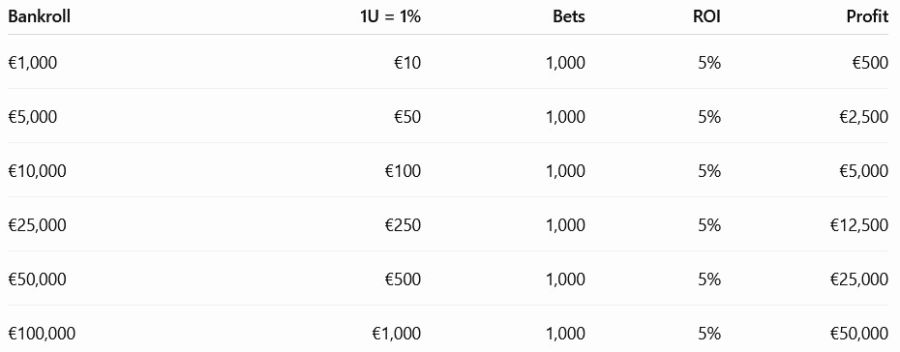
These calculations assume fixed stakes and a realized ROI of 5%.
In practice, liquidity, variance, and execution constraints may prevent the same performance from being reproduced at larger stake sizes.
14. Why Bankroll Scalability Is Essential
Bankroll scalability refers to the ability to increase the amount wagered while preserving the economic characteristics of a betting strategy.
This is a major consideration.
A strategy that is profitable with a €10 unit cannot necessarily be replicated with a €1,000 unit.
Why?
Because some markets cannot accommodate larger stakes at the same odds.
As stakes increase, several difficulties may arise:
- Insufficient market liquidity.
- Odds moving before a bet is executed.
- Limited market availability.
- Increased competition for profitable opportunities.
- Differences between the signaled odds and the odds actually obtained.
A genuinely scalable strategy should allow larger stakes without excessively reducing its edge.
15. The Importance of Liquidity at Pinnacle
Liquidity describes a market's ability to absorb betting volume.
At Pinnacle, betting limits can vary significantly depending on the sport, competition, market, and timing.
A match in a major football league may accommodate substantial wagers.
By contrast, certain niche sports or lower-division markets may offer much less liquidity.
A strategy producing a 5% ROI may be very attractive with €50 stakes.
But if its edge disappears when stakes reach €1,000, its scalability will be limited.
Profitability must therefore be assessed alongside available liquidity.
16. ROI and CLV: Two Complementary Metrics
ROI measures the financial results actually achieved.
Closing Line Value (CLV) compares the odds obtained with the closing odds.
Consider an example.
A bettor obtains Pinnacle decimal odds of:
2.10 (+110)
The closing odds are:
2.00 (+100)
The bettor secured a better price than the market's closing price.
This represents positive raw CLV.
Across a large sample, consistently positive CLV may strengthen the case that a bettor is obtaining favorable prices.
However, it does not guarantee a positive ROI.
Conversely, a positive ROI over a short period may result from favorable outcomes even when the bettor has not consistently secured good odds.
17. Why CLV Helps Interpret a 5% ROI
Imagine two tipsters, each displaying an ROI of +5%.
Tipster A
ROI:
+5%
Average CLV:
Positive
Track record:
3,000 bets
Tipster B
ROI:
+5%
Average CLV:
Negative
Track record:
100 bets
Their ROI is identical.
But the first has a longer track record and a potentially more favorable pricing signal.
This does not conclusively prove that the first tipster is better.
However, the results provide more evidence for assessing whether the edge may persist.
18. ROI Must Be Evaluated After Costs
A 5% ROI generally refers to the performance of the bets themselves.
However, bettors may incur additional costs, including:
- Tipster subscriptions.
- Service fees.
- Autobetting fees.
- Currency conversion fees.
- Technical expenses.
It is therefore essential to distinguish between:
Betting ROI
and:
Profit actually retained after costs.
A 5% betting ROI can be attractive, but fees reduce the final financial result.
19. Example Including Subscription Fees
Suppose:
Bankroll:
€5,000
Stake:
€50
Annual number of bets:
1,000
Realized ROI:
+5%
Betting profit:
€2,500
Now suppose the bettor pays a subscription of:
€49.95 per month
Over 12 months:
€49.95 × 12 = €599.40
Profit after subscription:
€2,500 - €599.40 = €1,900.60
The betting ROI remains 5%.
But the actual profit retained is lower.
The net return after the subscription, expressed as a percentage of the €50,000 betting turnover, is approximately:
3.80%
20. Why Fees Have a Greater Impact at Lower Betting Volumes
Let's keep the annual subscription cost at €599.40.
We will compare different betting volumes, assuming a €50 stake and a realized ROI of 5%.
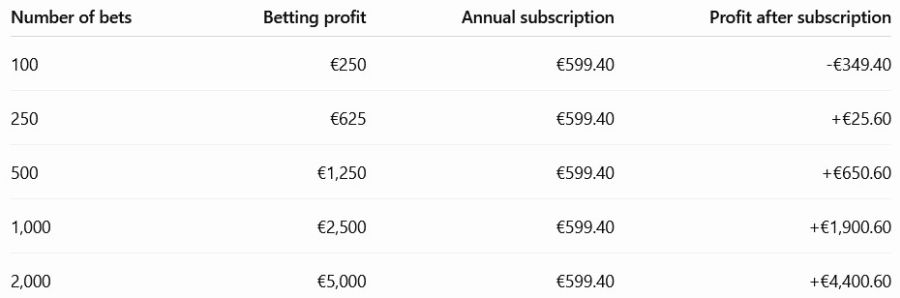
This example shows that the same ROI can produce very different financial results depending on volume.
Fixed costs represent a larger share of profits when fewer bets are placed.
21. The Break-Even Point for a Subscription
If ROI is 5% and each stake is €50, the expected profit per bet is:
€2.50
To cover an annual subscription costing €599.40, the theoretical number of bets required would be:
€599.40 ÷ €2.50 = 239.76 bets
Or approximately:
240 bets
This calculation assumes that the 5% EV is genuine and constant.
It does not guarantee that the subscription will actually be recovered after 240 bets.
Realized results can differ from expectations because of variance.
22. Autobetting Can Help Repeat an Edge
When a strategy has a positive edge, the ability to execute bets consistently becomes essential.
Autobetting can facilitate execution by reducing certain operational constraints.
In particular, it can help bettors:
- Follow selections without constant manual intervention.
- React quickly to betting opportunities.
- Apply predefined staking rules.
- Reduce the risk of missing selections.
- Maintain greater consistency in execution.
However, Autobetting does not create profitability by itself.
It automates the execution of a strategy.
Selection quality, odds actually obtained, and fees remain decisive.
23. Strategy Builder and the Search for a Repeatable Edge
Bet2invest's Strategy Builder allows users to study strategies using historical Pinnacle odds data.
For football, the historical dataset can cover up to 10 years.
For other sports, the available historical depth is shorter, with a five-year reference period.
The value of such a tool is not simply to search for the highest historical ROI.
It also involves analyzing:
- Sample size.
- Consistency of results.
- Opening and closing odds.
- Performance distribution.
- Drawdowns.
- The consistency of the observed advantage.
A strategy showing +5% over an extensive history may be more interesting than one showing +25% over a small sample.
However, historical results never guarantee future performance.
24. Why a Historical 5% ROI Must Be Tested Carefully
When a strategy is built using historical data, there is a risk of overfitting.
Overfitting occurs when a model matches the particular characteristics of historical data extremely well without necessarily possessing a repeatable advantage.
For example, a combination of criteria might produce a +15% ROI in a backtest.
But part of that performance may simply be due to chance.
To evaluate a strategy's robustness, it is useful to consider:
- The economic or statistical logic behind its criteria.
- Sample size.
- Stability across different time periods.
- Out-of-sample testing.
- Real execution costs and conditions.
- Whether historical odds could realistically have been obtained.
A profitable backtest is not proof of future profitability.
25. Can a 5% ROI Be Maintained for Ten Years?
It is possible, but never guaranteed.
Markets evolve.
Bookmakers improve their models.
Competition increases.
Some inefficiencies disappear.
A strategy that is profitable today may become less effective tomorrow.
The question is therefore not simply whether a strategy has produced a 5% ROI.
It is also whether the reasons behind that performance are likely to persist.
Monitoring CLV, liquidity, and recent performance can help identify possible deterioration.
26. Why Consistency Matters as Much as Returns
Two strategies may achieve the same ROI over several years while following very different paths.
The first may produce relatively steady results.
The second may experience long losing periods followed by substantial gains.
Their final return is identical.
But their risk profiles are not.
For a bettor, this distinction is crucial.
A strategy that is psychologically difficult to follow can lead to mistakes such as:
- Stopping after a drawdown.
- Increasing stakes to recover losses.
- Reducing stakes after a losing streak.
- Abandoning a strategy before its edge has had sufficient opportunity to materialize.
27. Drawdown Must Be Included in ROI Analysis
Maximum Drawdown measures the largest observed decline from a peak to a subsequent trough in a capital or performance curve.
Imagine two strategies.
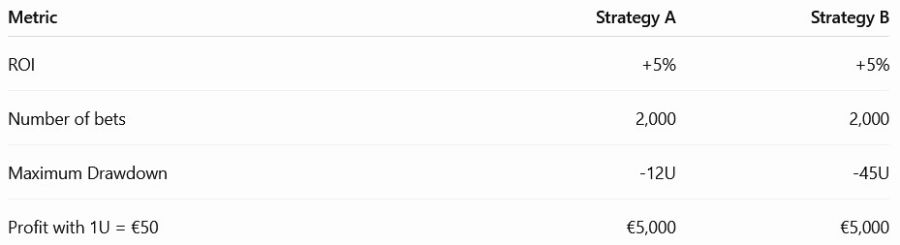
Both strategies have generated the same profit.
However, Strategy B experienced a much larger maximum decline.
For some bettors, this difference may justify using a smaller unit or allocating capital differently.
28. A Positive ROI Does Not Prevent Long Losing Periods
Even a strategy with positive EV can suffer substantial losses.
Consider a strategy with:
Theoretical ROI: +5%
This does not mean it will earn 5% every week or every month.
It could experience:
- A month at -8%.
- Another at +3%.
- A period at -12%.
- Then a recovery period.
The final outcome depends on the distribution of results.
Variance does not disappear simply because expected value is positive.
29. Why You Should Avoid Fixed Daily Profit Targets
Some bettors aim to earn a predetermined amount every day.
For example:
€50 per day
However, positive-edge opportunities do not necessarily appear at a constant frequency.
Trying to reach a daily target can encourage bettors to:
- Artificially increase the number of bets.
- Accept less attractive odds.
- Increase stakes after a loss.
- Abandon their selection criteria.
It is generally more sensible to focus on opportunity quality and disciplined execution rather than a daily profit target.
30. The Difference Between Linear Growth and Compounding
So far, we have used fixed stakes.
With a constant €50 unit, theoretical profit increases linearly with the number of bets, provided ROI remains unchanged.
However, some bettors gradually adjust their unit size as their bankroll changes.
For example:
Initial bankroll:
€5,000
Initial unit:
€50
If the bankroll reaches €6,000, a unit equal to 1% would become:
€60
This approach allows stakes to grow with capital.
This is the principle of compounding.
However, it also increases the absolute amount that can be lost as stakes grow.
31. Compounding Can Accelerate Growth, but Also Losses
Consider two approaches.
Approach A: Fixed Stakes
The unit remains:
€50
even as the bankroll grows.
Approach B: Percentage-Based Staking
The unit always represents:
1% of the current bankroll
It increases when the bankroll grows.
It decreases when the bankroll falls.
The second approach automatically adjusts exposure to available capital.
However, it does not guarantee better final performance.
The result depends on actual returns, the sequence of wins and losses, and the risk taken.
32. Theoretical Example of Compounded Growth
Suppose the initial bankroll is:
€5,000
For illustration only, assume net growth of:
10% per period
with all profits reinvested.
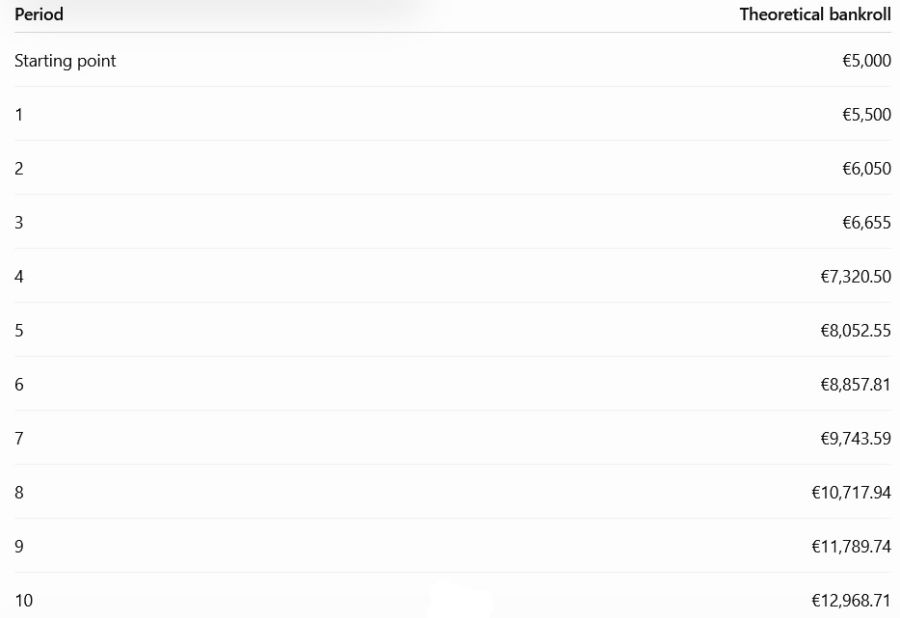
This example illustrates compound growth.
It does not represent a 5% ROI per bet and is not a sports betting performance forecast.
In reality, returns fluctuate and may be negative.
33. Why ROI and Compound Growth Must Not Be Confused
A betting strategy's ROI measures profit relative to total stakes.
Compound growth measures how capital changes when profits are reinvested.
These concepts are related, but different.
A 5% ROI does not mean the bankroll automatically grows by 5% every month.
Nor does it mean the bankroll grows by 5% every year.
The outcome depends on:
- Number of bets.
- Stake sizes.
- Results actually achieved.
- Fees.
- How profits are managed.
- Any withdrawals.
Maintaining this distinction is essential in financial projections.
34. Annual Betting Volume Can Transform Financial Results
Let's return to a fixed €50 unit.
Consider different levels of betting activity over one year.
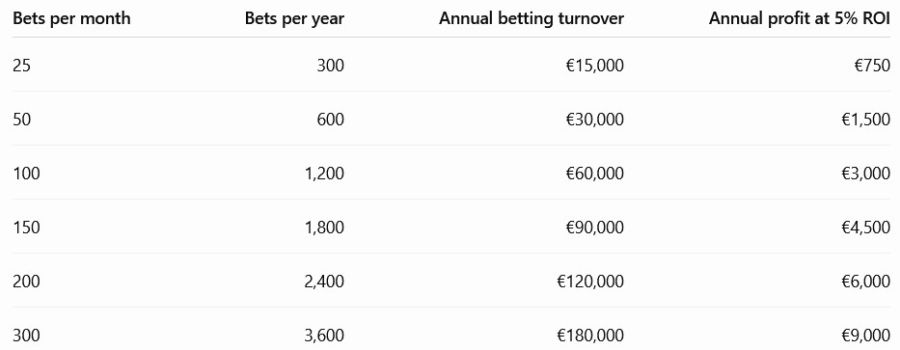
These figures are theoretical.
They assume a realized ROI of 5% across all bets.
Fees are not included.
35. Can You Make a Living With a 5% ROI?
The answer mainly depends on three variables:
Achievable betting turnover
Stake size
The ability to maintain an edge
Consider a gross profit target of:
€30,000 per year
With a 5% ROI, the required betting turnover is:
€30,000 ÷ 0.05 = €600,000
If the bettor places 2,000 bets per year, the required average stake is:
€600,000 ÷ 2,000 = €300
With a unit equal to 1% of bankroll, this corresponds to a reference bankroll of:
€30,000
This is a mathematical illustration, not a guaranteed income.
The bettor would still need to execute 2,000 bets of €300 at sufficiently favorable odds, withstand drawdowns, and cover all associated costs.
36. How Much Betting Turnover Is Needed to Target Different Profits?
At a constant 5% ROI, here is the annual betting turnover required to reach different gross profit levels.
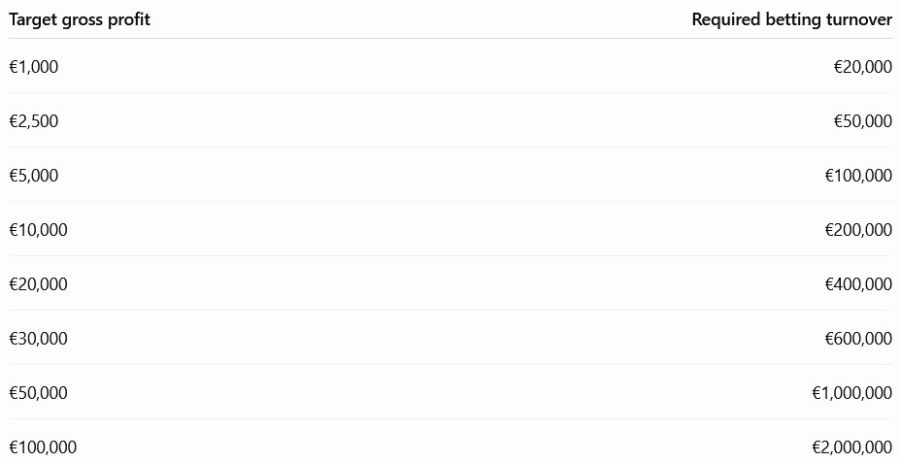
These figures help illustrate the economic potential of a 5% ROI.
They also demonstrate the requirements involved in scaling a betting operation.
37. Why Professionals Prioritize Sustainability
A spectacular ROI over a few dozen bets may attract attention.
But sustainable performance depends much more on:
- A genuine edge.
- Competitive odds.
- Disciplined execution.
- Consistent bankroll management.
- Sufficient liquidity.
- Repeatable betting volume.
- Controlled drawdowns.
- Serious statistical analysis.
A more modest ROI supported by thousands of bets may be economically more valuable than an exceptional performance that is difficult to reproduce.
38. Comparing Two Tipsters: ROI or Profit Potential?
Imagine two tipsters.
Tipster A
Historical ROI:
+12%
Annual number of bets:
200
Tipster B
Historical ROI:
+5%
Annual number of bets:
2,000
With a €50 unit:
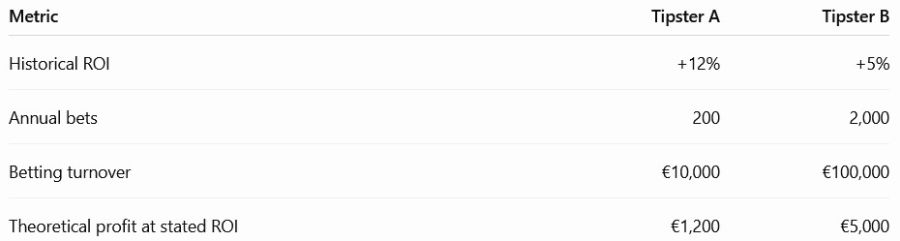
Tipster B could generate substantially more profit despite having a lower ROI.
However, this comparison assumes that historical performance is repeated.
Subscriptions, fees, odds actually obtained, and market liquidity must also be considered.
39. The Role of Flat Stakes Summary (1U)
To compare strategies consistently, Flat Stakes Summary (1U) provides a valuable standardized reference.
Each selection is evaluated using an identical unit.
This makes it possible to observe:
Profit in units
ROI
Sample size
Drawdowns
and:
Consistency of performance
without mixing the quality of the selections with individual stake-sizing decisions.
A strategy generating +100U over a substantial betting history deserves a different analysis from one generating +10U over a small sample.
However, unit-based performance must always be interpreted alongside betting volume and the risks involved.
40. Twelve Mistakes to Avoid When Evaluating a 5% ROI
- Assuming a 5% ROI is necessarily low.
- Confusing betting ROI with return on the initial bankroll.
- Ignoring total betting turnover.
- Increasing the number of bets without checking their edge.
- Comparing tipsters solely by ROI.
- Neglecting sample size.
- Ignoring drawdowns and variance.
- Assuming historical ROI will automatically continue.
- Forgetting subscriptions and execution fees.
- Increasing stakes without checking available liquidity.
- Confusing compound growth with ROI per bet.
- Setting unrealistic profit targets that encourage excessive risk-taking.
Conclusion
Why can a 5% ROI become highly profitable?
Because ROI is only one part of the equation.
Financial profit also depends on betting turnover.
A 5% ROI applied to €10,000 in stakes produces a €500 profit.
The same ROI applied to €100,000 in stakes produces €5,000.
And across €1,000,000 in stakes, it represents €50,000.
But this progression is possible only when several conditions are met.
A genuine edge must exist.
Enough betting opportunities must be available.
The bettor must obtain favorable odds.
The bankroll must be appropriately sized.
Stakes must be scalable without destroying the edge.
And, most importantly, the bettor must be able to withstand the inevitable fluctuations in results.
A sustainable 5% ROI over substantial betting volume can be far more valuable than a spectacular ROI over a small sample.
The priority should therefore not be to chase the most impressive percentage.
It should be to develop a profitable, statistically credible, repeatable method supported by disciplined bankroll management.
It is the combination of ROI, volume, edge, liquidity, and discipline that can turn a seemingly modest return into a meaningful financial result.
FAQ: Bankroll and ROI
Is a 5% ROI Good in Sports Betting?
Yes. A 5% ROI maintained over a large number of bets can be an excellent performance. However, sample size, odds, CLV, and drawdowns must also be examined to assess its reliability.
What Does a 5% ROI Mean?
It means net betting profit represents 5% of total stakes. For example, €50,000 in wagers at a realized 5% ROI produces €2,500 in profit.
Does a 5% ROI Mean My Bankroll Grows by 5%?
- ROI is calculated using total betting turnover, not the initial bankroll. The return on bankroll can be higher or lower.
How Much Does a 5% ROI Generate Over 1,000 Bets of €50?
Total betting turnover is €50,000. A realized 5% ROI therefore corresponds to €2,500 in profit.
Why Is the Number of Bets Important?
Because at the same ROI, higher betting turnover generates greater financial profit. However, the statistical edge must remain present.
Is a 20% ROI Always Better Than a 5% ROI?
- Betting volume, sample size, variance, drawdown, and repeatability must all be considered.
Can You Achieve a 5% ROI With Low-Odds Bets?
Yes, provided the odds obtained are sufficiently high relative to the true probabilities of the events.
Is CLV Important When Evaluating ROI?
Yes. Consistently positive CLV can provide additional information about the quality of the prices obtained, but it does not guarantee profitability.
Can I Increase My Unit When My Bankroll Grows?
Yes, as part of a percentage-based staking method. However, this also increases the absolute size of potential profits and losses.
Can Autobetting Improve Profitability?
It can facilitate consistent and timely execution, but it does not create an edge or guarantee a positive ROI.
How Much Do I Need to Wager to Earn €10,000 at a 5% ROI?
You would need €200,000 in cumulative stakes to generate €10,000 in profit at a realized 5% ROI, before fees.
What Is the Most Important Rule?
Do not focus solely on finding the highest ROI. Look for a credible edge, repeatable betting volume, competitive odds, and bankroll management capable of withstanding variance.