How to Manage Your Bankroll When Following Multiple Tipsters
Following multiple Tipsters may seem like a simple way to diversify your sports betting activity.
One Tipster specializes in football.
Another in tennis.
A third in Asian markets.
Another may focus on niche sports or leagues.
In theory, this diversification can help reduce your dependence on a single strategy.
But it also introduces a new challenge:
how do you manage a single bankroll when several Tipsters generate bets at the same time?
Following five Tipsters with a 1U Stake per bet does not mean your risk automatically remains limited to 1% of your bankroll.
If several selections are open simultaneously, your total exposure can quickly become significant.
Managing a multi-Tipster bankroll should therefore be approached like managing a portfolio.
In this article, we will use our usual example:
Initial Bankroll: €5,000
1U = €50
or:
1% of the initial Bankroll
Why Follow Multiple Tipsters?
The first reason is usually diversification.
A single Tipster can go through a difficult period.
Even when they genuinely have an Edge, they may experience:
Variance
losing streaks
Drawdown
or simply a period when their particular market is less favorable.
By following several genuinely different strategies, it becomes possible to spread risk.
However, an important distinction must immediately be made:
multiple Tipsters do not automatically mean multiple independent sources of Edge.
Two Tipsters may use very similar approaches.
They may bet on the same leagues.
They may operate at the same times.
They may target the same markets.
They may even regularly select the same events.
True diversification therefore does not depend solely on the number of Tipsters.
It depends primarily on how their performance and exposure are related.
One Bankroll or Several Bankrolls?
A common question is:
should you create a separate Bankroll for each Tipster?
For example, with €5,000 and five Tipsters:
Tipster A: €1,000
Tipster B: €1,000
Tipster C: €1,000
Tipster D: €1,000
Tipster E: €1,000
This method is easy to understand.
But it can be somewhat artificial.
If all bets are actually financed by the same €5,000, then economically there is only one Bankroll.
Creating five accounting sub-bankrolls does not change the overall risk.
A more coherent approach is often to consider:
one global Bankroll
and then control the exposure generated by each Tipster within that Bankroll.
Example With Three Tipsters
Consider a Bankroll of:
€5,000
with:
1U = €50
We follow three Tipsters:
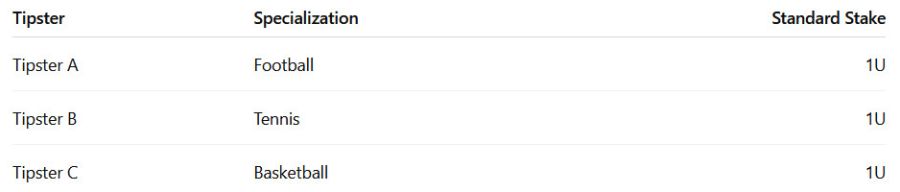
Each bet represents:
€50
Individually, the risk appears small.
But imagine that during the same day:
Tipster A publishes 4 bets.
Tipster B publishes 5 bets.
Tipster C publishes 3 bets.
That represents:
12 bets
At €50 per bet:
12 × €50 = €600
Potential exposure therefore reaches:
12U
or:
12% of the initial Bankroll
The real risk should therefore not be analyzed only:
bet by bet
but also:
at the overall portfolio level.
Cumulative Exposure Is Fundamental
When following multiple Tipsters, one of the most important metrics becomes:
total simultaneous exposure.
Suppose you have:
10 open bets
with:
1U = €50
Your exposure is:
10U = €500
or:
10% of your initial Bankroll
With 20 open bets:
20U = €1,000
or:
20% of the Bankroll
Even though each individual bet represents only 1%, cumulative exposure can become significant.
Therefore:
a conservative Stake at the individual bet level does not automatically guarantee conservative exposure at the portfolio level.
The Number of Tipsters Is Not the Main Issue
Following:
2 Tipsters
5 Tipsters
or even:
10 Tipsters
is not necessarily a problem in itself.
The more important question is:
how many bets can be open at the same time?
One Tipster may publish only:
30 bets per month
while another publishes:
300
The second Tipster can therefore use much more capital.
You need to consider:
betting frequency
and not simply the number of Tipsters being followed.
Not All Tipsters Use the Same Amount of Bankroll
Consider two Tipsters.
Tipster A
30 bets per month
Stake:
1U
Tipster B
200 bets per month
Stake:
1U
Even if every bet has exactly the same Stake, Tipster B generates much more exposure over the course of a month.
This does not necessarily mean that Tipster B is riskier.
But it does mean that their strategy uses the Bankroll much more frequently.
The number of selections should therefore be included in the analysis.
Frequency Is Not the Same as Risk
An important distinction must be made.
A Tipster publishing 300 bets per month is not necessarily three times riskier than a Tipster publishing 100.
Risk also depends on:
Odds
Variance
Hit Rate
Drawdown
correlation between bets
and:
how concentrated those bets are over time
Three hundred bets distributed evenly throughout a month do not produce the same exposure as 300 bets concentrated over a few days.
What Is Correlation Between Tipsters?
Correlation is probably one of the most important concepts when managing a portfolio of Tipsters.
Consider two Tipsters specializing in:
European football
They may regularly bet on the same competitions:
Premier League
La Liga
Serie A
Bundesliga
Champions League
They may also use similar models based on the same market information.
Their performance may therefore move in relatively similar ways.
By contrast, a football Tipster and a tennis Tipster may have much more independent performance profiles.
Diversification is more effective when strategies do not all react in the same way to the same market conditions.
Example of False Diversification
Imagine following five Tipsters.
This may appear highly diversified.
But suppose all five specialize in:
Totals in European football
and mainly use:
the same bookmakers
the same markets
the same time periods
and similar methods.
You may not really have five independent strategies.
You may actually have:
five variations of the same exposure.
The number of Tipsters can therefore create an illusion of diversification.
Example of More Genuine Diversification
Now consider four Tipsters:
Tipster A
Football, major markets
Tipster B
Tennis
Tipster C
Basketball
Tipster D
Niche sports
Their schedules, markets, Odds and sources of Edge may be very different.
Their Drawdowns may therefore not occur simultaneously.
This diversification can make the overall portfolio more stable.
But diversification should always be measured rather than assumed.
Drawdown Should Be Analyzed Individually and Globally
When several Tipsters are followed, there are two levels of Drawdown.
Individual Drawdown
The Drawdown specific to each Tipster.
Portfolio Drawdown
The Drawdown generated by all Tipsters combined.
The second is what actually determines the evolution of your Bankroll.
One Tipster may experience:
-15U
while another generates:
+10U
The combined result may therefore be much more stable.
Conversely, if several Tipsters experience their Maximum Drawdown simultaneously, the decline in your Bankroll may become significant.
Do Not Simply Add Maximum Drawdowns Together
Suppose:
Tipster A: historical MDD of -20U
Tipster B: -15U
Tipster C: -18U
Simply adding:
20 + 15 + 18 = 53U
does not necessarily mean the portfolio will experience a 53U Drawdown.
Those Drawdowns may occur at different times.
But the opposite is also true:
it would be dangerous to assume that they can never occur simultaneously.
Proper analysis therefore requires examining combined performance over time.
Diversification Can Reduce Overall Drawdown
Consider two independent strategies.
When the first goes through a negative period, the second may continue generating positive results.
The portfolio can therefore produce a smoother equity curve than either strategy individually.
This is one of the main advantages of a multi-Tipster portfolio.
But this advantage depends directly on correlation.
If the strategies are highly correlated, the diversification benefit decreases.
How Should Units Be Allocated Between Multiple Tipsters?
The simplest solution is to maintain:
1U = 1% of the global Bankroll
for all Tipsters.
With our €5,000 Bankroll:
1U = €50
Therefore, regardless of the Tipster:
1U = €50
This approach has an important advantage:
all performance remains expressed using the same reference Unit.
This makes it easier to manage:
tracking
comparison
and:
overall portfolio exposure
Why Avoid a Different Unit for Each Tipster?
Imagine:
Tipster A:
1U = €50
Tipster B:
1U = €100
Tipster C:
1U = €25
The portfolio immediately becomes more difficult to understand.
If A loses 5U, B gains 3U and C loses 4U, the result in Units no longer directly represents the portfolio result.
You constantly need to convert performance back into euros.
Using a common Unit across the entire portfolio makes the analysis much more transparent.
Should You Always Bet 1U on Every Tipster?
Not necessarily.
A common Unit can serve as a reference without requiring exactly the same exposure for every strategy.
For example:
Tipster A: 1U per bet
Tipster B: 0.5U per bet
Tipster C: 1U per bet
If Tipster B has:
a shorter track record
a higher Drawdown
greater Variance
or:
a less firmly established Edge
it may be rational to reduce their allocation.
However, the difference should be based on objective criteria.
Not simply on intuition.
Historical Quality Should Be Considered
Before assigning an allocation to a Tipster, several indicators can be examined:
Sample Size
ROI
Flat Stakes Summary (1U)
CLV
Maximum Drawdown
Variance
Average Odds
betting frequency
Liquidity
and:
the length of the track record
A Tipster with 5,000 verified bets does not carry the same level of uncertainty as a Tipster with only 150 selections.
Sample Size Is Particularly Important
Consider two Tipsters.
Tipster A
150 bets
ROI:
+12%
Tipster B
4,000 bets
ROI:
+5%
It would be dangerous to automatically conclude that Tipster A deserves a larger allocation.
Their ROI is higher.
But their Sample Size is much smaller.
Part of that difference may simply come from Variance.
Allocation should therefore take into account not only observed performance but also:
the level of uncertainty surrounding that performance.
CLV Can Help Assess Robustness
CLV can provide additional information.
If a Tipster consistently obtains better Odds than the Closing Odds, this can be an interesting signal regarding the quality of their process.
Conversely, a high ROI combined with consistently negative CLV may require further analysis.
However, CLV should not be used in isolation.
It should be combined with:
ROI
Sample Size
Drawdown
and:
Flat Stakes Summary (1U)
Watch Out for Duplicate Bets
When following multiple Tipsters, a specific problem can arise:
several Tipsters may publish the same selection.
Imagine three Tipsters recommending:
the same team at the same Odds
with:
1U each
If you execute all three recommendations, your real exposure is no longer:
1U
but:
3U
or:
€150
which represents:
3% of your initial Bankroll
on the same event.
You should therefore decide in advance how duplicate selections will be handled.
A Duplicate Bet Does Not Mean Three Independent Edges
If three Tipsters recommend the same selection, this may increase your confidence.
But it does not mean you have three independent bets.
The outcome is identical for all three positions.
If the selection loses:
all three Stakes lose simultaneously.
From a Risk Management perspective, cumulative exposure to the event should therefore be considered.
Set Maximum Exposure Per Event
A simple rule can be used.
For example:
maximum exposure per event = 2U
With:
1U = €50
this means:
a maximum of €100 on the same event
even if three Tipsters recommend the same selection.
This prevents convergence between multiple Tipsters from unintentionally turning a Flat Betting strategy into a highly concentrated position.
Set Maximum Simultaneous Exposure
It can also be useful to define a global limit.
For example:
maximum simultaneous exposure = 15U
With our Bankroll:
15U × €50 = €750
or:
15% of the initial Bankroll
If this limit is reached, additional selections require a risk-management decision.
This prevents a particularly busy day from creating excessive exposure.
Watch Out for Time Concentration
Sports bets are not distributed evenly over time.
Saturday afternoon may concentrate:
English football
German football
Italian football
Spanish football
and many other competitions.
If several Tipsters are active in these markets, dozens of bets may be open simultaneously.
The average number of bets per day can therefore be misleading.
Another important factor is:
peak exposure.
Average Exposure and Maximum Exposure
Two indicators can be particularly useful.
Average Exposure
The average amount of capital committed simultaneously.
Maximum Exposure
The maximum amount of capital committed at any one time.
A strategy may have reasonable average exposure but occasionally experience very large peaks.
From a Risk Management perspective, these peaks need to be monitored.
Should You Reduce Your Unit When Adding More Tipsters?
That depends on the total exposure generated.
Suppose that with two Tipsters, a Unit of:
1%
produces a historical maximum exposure of:
8% of the Bankroll
You then add four more Tipsters.
Maximum exposure could increase to:
20%
or more.
In that case, keeping exactly the same Unit can significantly change your risk profile.
One possible solution is to move from:
1U = 1%
to:
1U = 0.5%
With a €5,000 Bankroll:
1U = €25
The appropriate Unit size therefore also depends on the complete portfolio.
Example With a Smaller Unit
Suppose six Tipsters can simultaneously generate:
20 bets
With:
1U = €50
the exposure would be:
€1,000
or:
20% of the Bankroll
With:
1U = €25
exposure becomes:
€500
or:
10% of the Bankroll
The number of Tipsters remains exactly the same.
But the risk profile changes considerably.
The Appropriate Unit Therefore Depends on the Portfolio
With an individual strategy, you might ask:
“What percentage of my Bankroll should I bet on each selection?”
With a multi-Tipster portfolio, you also need to ask:
“How many bets can be open simultaneously?”
and:
“How correlated are those bets?”
The appropriate Unit cannot always be determined by looking at a single bet in isolation.
Tipsters With High Odds Require Particular Attention
Consider two Tipsters.
Tipster A has average Odds of:
1.80
Tipster B:
4.50
Even with the same 1U Stake, their Variance profiles will be very different.
Tipster B may experience much longer losing streaks.
Their allocation should therefore be analyzed with this Variance in mind.
A high ROI alone is not enough to determine risk.
The Number of Simultaneous Bets Matters More Than the Number of Subscriptions
You can subscribe to:
10 Tipsters
without necessarily having significant exposure if each one publishes relatively few bets.
Conversely, following only:
3 highly active Tipsters
can generate considerable exposure.
For Bankroll Management, it is therefore more useful to track:
the number of open positions
rather than simply:
the number of subscriptions.
Liquidity and Multiple Tipsters
Liquidity also becomes important when several strategies are being used.
A market that can absorb:
€50
without difficulty may not allow:
€500
at the same Odds.
If several Tipsters recommend the same market, theoretical exposure may exceed the actual available capacity.
It is therefore important to distinguish between:
theoretical Stake
and:
actually executable Stake.
Bankroll size must remain compatible with the Liquidity of the markets being used.
Autobetting and Portfolio Management
Autobetting can significantly simplify execution when following multiple Tipsters.
But automation does not remove the need for Risk Management.
On the contrary, when bets can be executed automatically and very quickly, it becomes even more important to define in advance:
Unit size
maximum exposure
limits per Tipster
limits per event
and:
maximum global exposure
Automation should execute a predefined risk strategy, not replace it.
Should You Allocate More Capital to the Best Tipsters?
Intuitively, this may seem logical.
But the term:
“best Tipster”
needs to be defined carefully.
Is it the Tipster with:
the highest ROI?
the best CLV?
the largest Sample Size?
the lowest Drawdown?
the best risk-adjusted return?
A Tipster with an 8% ROI and a 40U MDD does not have the same profile as a Tipster with a 5% ROI and a 12U MDD.
Allocation should therefore consider several dimensions.
Avoid Overweighting Recent Performance
A Tipster has just generated:
+15U in one month
It may be tempting to immediately increase their Stake.
But this result may simply represent a positive period of Variance.
Conversely, significantly reducing a Tipster's allocation after:
-10U
may be a mistake if their Edge remains intact.
Constantly changing allocations according to recent results can create:
Performance Chasing
Exposure is increased after strong periods and reduced after poor ones.
This behavior can be counterproductive.
Allocation Rules Should Be Defined in Advance
A more rigorous approach is to establish criteria.
For example, allocation may depend on:
Sample Size
ROI
CLV
Maximum Drawdown
Variance
Liquidity
correlation with other Tipsters
and:
strategy stability
These rules should ideally be defined before looking at recent results.
This helps reduce emotional decisions.
Simple Multi-Tipster Allocation Example
Consider a Bankroll of:
€5,000
with a reference Unit of:
1U = €50
We follow four Tipsters.
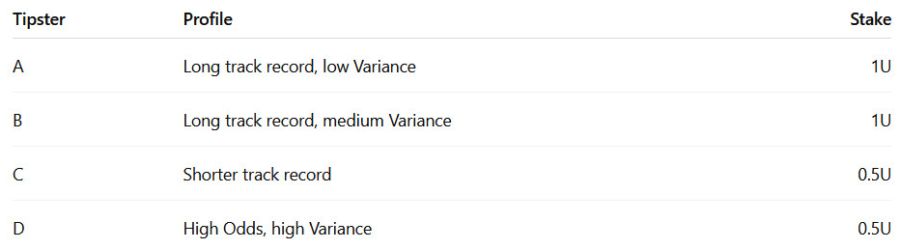
The Stakes become:
Tipster A:
€50
Tipster B:
€50
Tipster C:
€25
Tipster D:
€25
This structure keeps a common Unit while adapting exposure to risk and uncertainty.
Another Approach: Equal Allocation
An even simpler method is to use:
1U for every Tipster
This approach may be appropriate when the strategies have:
comparable levels of validation
large Sample Sizes
and:
relatively similar risk profiles
Its main advantage is that it is extremely easy to manage.
Equal Allocation Does Not Mean Equal Risk
Even with 1U for everyone, each Tipster does not necessarily contribute equally to overall risk.
A Tipster publishing:
200 bets per month
and another publishing:
30
will not contribute to the portfolio in the same way.
Similarly, a Tipster specializing in high Odds will generally have a different Variance profile.
The actual contribution of each strategy to total risk should therefore be analyzed.
The Portfolio Should Be Analyzed as a Single Strategy
This is probably the most important principle in this article.
Once several Tipsters are combined, analyzing each one separately is no longer enough.
You also need an overall view.
For example:
Global ROI
Global Profit
Global Maximum Drawdown
Global Variance
Maximum Exposure
Maximum Number of Simultaneous Bets
Correlation Between Tipsters
and:
Global Flat Stakes Summary
The portfolio itself becomes:
a strategy.
Backtesting a Combination of Tipsters
When historical data is available, one particularly useful method is to reconstruct what would have happened if several Tipsters had been followed simultaneously.
This allows you to observe:
the Bankroll curve
Maximum Drawdown
losing periods
exposure peaks
and:
portfolio stability
Different combinations can then be compared.
For example:
A + B
A + C
A + B + C
A + B + C + D
Adding a Tipster is useful only if they improve the portfolio sufficiently relative to the additional risk they introduce.
Be Careful With Hindsight Bias
However, this type of analysis requires caution.
Selecting only the Tipsters with the strongest historical results after the fact can create significant bias.
You may build a portfolio that is perfectly optimized for the past but much less effective in the future.
As with Strategy Builder or any Backtest:
Overfitting must be monitored.
A Diversified Portfolio Can Have a Lower ROI but Be More Robust
Imagine:
Tipster A Alone
ROI:
+8%
Maximum Drawdown:
-25U
Portfolio A + B + C
ROI:
+6%
Maximum Drawdown:
-12U
The portfolio has a lower ROI.
But its risk profile may be very different.
This illustrates why a portfolio should not be evaluated solely on ROI.
You should also examine:
stability
Drawdown
Variance
and:
overall risk.
Unused Capital Is Not Necessarily a Problem
Some bettors constantly try to keep their entire Bankroll committed.
This is not necessary.
A Bankroll of:
€5,000
may have only:
€500
committed at a particular moment.
The remaining:
€4,500
is not “unused.”
It represents:
the capital reserve that allows the strategy to absorb Variance and future Drawdowns.
A Bankroll does not need to be 100% invested at all times.
The Safety Reserve
When following multiple Tipsters, maintaining a safety margin becomes particularly important.
If the entire Bankroll is regularly committed, the ability to absorb:
a losing streak
a spike in betting volume
or:
several simultaneous Drawdowns
is significantly reduced.
Part of the Bankroll should therefore remain available.
This reserve is an integral part of Risk Management.
Should Kelly Be Used With Multiple Tipsters?
It is possible.
But the difficulty increases considerably.
Kelly should no longer be applied independently to each bet without considering:
total exposure
correlations
simultaneous bets
and:
the uncertainties associated with each model or Tipster
A rigorous application of Kelly in a multi-strategy portfolio therefore becomes a portfolio allocation problem.
For many users, Flat Betting or Fractional Kelly with exposure limits may be easier to control.
A Simple Framework for Managing Multiple Tipsters
A practical approach can be organized around several rules.
1. Define a Global Bankroll
For example:
€5,000
2. Define a Common Unit
For example:
1U = €50
3. Determine the Stake for Each Tipster
For example:
0.5U
1U
or potentially more if statistically justified.
4. Set Maximum Exposure Per Event
For example:
2U
5. Set Maximum Simultaneous Exposure
For example:
15U
6. Monitor Correlation
Avoid unintentionally accumulating several almost identical strategies.
7. Measure Global Drawdown
Do not look only at individual Drawdowns.
8. Reassess Periodically
Based on data, not on the results of the last three days.
Complete Example
Consider:
Bankroll: €5,000
1U: €50
Four Tipsters are being followed.
Tipster A
Stake:
1U
4 open bets:
€200
Tipster B
Stake:
1U
3 open bets:
€150
Tipster C
Stake:
0.5U
4 open bets:
€100
Tipster D
Stake:
0.5U
2 open bets:
€50
Total exposure:
€200 + €150 + €100 + €50 = €500
or:
10% of the Bankroll
From a Risk Management perspective, this information is far more important than simply saying:
“I follow four Tipsters.”
Indicators to Monitor
To properly manage a multi-Tipster Bankroll, several indicators can be particularly useful:
Total Bankroll
Unit
Average Stake
Number of Tipsters
Number of Open Bets
Simultaneous Exposure
Maximum Exposure Per Event
ROI per Tipster
Global ROI
Flat Stakes Summary (1U)
CLV
Individual Maximum Drawdown
Global Maximum Drawdown
Variance
Sample Size
Average Odds
Liquidity
and:
Correlation Between Strategies
This overall view allows you to move from simply accumulating subscriptions to a genuine portfolio approach.
Mistakes to Avoid
When following multiple Tipsters, certain mistakes are particularly common.
- Creating a different Unit for each Tipster without a clear reason.
- Looking only at the individual Stake.
- Ignoring total simultaneous exposure.
- Assuming multiple Tipsters automatically provide diversification.
- Ignoring duplicate selections.
- Accumulating several Stakes on the same event without a limit.
- Overweighting the Tipster with the strongest recent performance.
- Immediately reducing a Tipster after a losing streak.
- Ignoring Sample Size.
- Ignoring Global Maximum Drawdown.
- Ignoring correlation.
- Committing the entire Bankroll simultaneously.
- Continuously adding Tipsters without recalculating Unit size.
- Confusing the number of Tipsters with the level of diversification.
- Looking only at ROI without considering risk.
Conclusion
Following multiple Tipsters can help build a more diversified sports betting portfolio.
But diversification is not automatic.
The real objective is not simply:
to add more Tipsters
but to combine several sources of Edge while controlling:
exposure
Variance
Drawdown
correlation
and:
Risk of Ruin
With our reference Bankroll of:
€5,000
and:
1U = €50 = 1%
the key principle is not to consider each bet in isolation.
A 1U bet may appear conservative.
But:
15 simultaneous bets at 1U represent 15U of exposure.
Managing a multi-Tipster Bankroll should therefore be approached like managing a portfolio.
Each Tipster represents a strategy.
But all Tipsters combined also represent:
one global strategy.
This global strategy should be analyzed through:
its ROI
its Maximum Drawdown
its Variance
its Maximum Exposure
its correlations
and:
the stability of its Bankroll curve.
The question is therefore not simply:
“How many Tipsters can I follow?”
The more important question is:
“How much total exposure can my Bankroll support when all my Tipsters are active at the same time?”
FAQ: Managing Your Bankroll With Multiple Tipsters
Should I Create a Separate Bankroll for Each Tipster?
Not necessarily. If all bets are funded by the same capital, it is often more coherent to consider one global Bankroll and control each Tipster's exposure within it.
Can I Use the Same Unit for Every Tipster?
Yes. A common Unit makes portfolio comparison and management much easier. With a €5,000 Bankroll, for example, 1U could represent €50.
Should I Bet Exactly 1U on Every Tipster?
Not necessarily. Some Tipsters may receive 0.5U or 1U depending on their Sample Size, Variance, Drawdown, track record and the robustness of their Edge.
Does Following More Tipsters Automatically Reduce Risk?
No. If several Tipsters use highly correlated strategies, diversification may be much lower than it appears.
What Should I Do if Several Tipsters Give the Same Bet?
It can be useful to define maximum exposure per event. Three Tipsters recommending the same selection do not represent three independent risks.
Should I Reduce My Unit When Adding More Tipsters?
It may be necessary if adding Tipsters significantly increases the number of simultaneous bets and the portfolio's maximum exposure.
What Is the Most Important Indicator?
There is no single indicator. ROI should be analyzed alongside Maximum Drawdown, Variance, Sample Size, CLV, simultaneous exposure and correlations.
Can Kelly Be Used With Multiple Tipsters?
Yes, but it becomes more complex because total exposure and correlations between different positions must also be considered.
Why Monitor Global Maximum Drawdown?
Because the combination of all Tipsters is what actually determines the evolution of your Bankroll.
What Is the Main Rule to Remember?
Do not think only in terms of Stake per bet. When following multiple Tipsters, you need to think in terms of total portfolio exposure.
Friday, September 25, 2026
Bet2Invest is not a bookmaker and does not offer sports betting services. However, its content is related to sports betting activities.
Gambling is strictly prohibited for minors. Play responsibly — excessive gambling can lead to financial loss, debt, or addiction.